
Manges Lectures
The Annual Horace S. Manges Lecture
The Horace S. Manges Lecture & Conference Fund was established by the law firm of Weil, Gotshal & Manges in 1986 in memory of its esteemed partner, Horace S. Manges, Law ’19. Mr. Manges was a distinguished trial lawyer and was counsel to leading writers and publishers and to the American Book Publishers Council (now the Association of American Publishers). A founder, officer and trustee of the Copyright Society of the U.S.A. (now the Copyright Society), he also performed important government service and played an active role in the development of copyright legislation.
2026: The Rt. Hon. Lord Justice Richard Arnold
On Monday, April 13, 2026, The Rt. Hon. Lord Justice Richard Arnold of the UK Court of Appeal delivered the 38th Annual Manges Lecture, “Performers’ Rights: International, UK and US Law.”
The Manges Lecture and Conference Fund was established by the law firm of Weil, Gotshal & Manges in 1986 in memory of its esteemed partner, Horace S. Manges, Columbia Law School, class of 1919. Generous contributions to the fund were made by Mr. Manges' family, friends, colleagues, clients, and other associates. He was a distinguished trial lawyer and counsel to leading writers and publishers, and to the American Book Publishers, the organization now known as the Association of American Publishers, or AAP.
Mr. Manges was a founder, officer, and trustee of the Copyright Society of the USA. He also performed important government service and played an active role in the development of copyright legislation. And we honor him tonight. And Jane Ginsburg is now going to talk a little bit about our speaker.
[PROF. JANE GINSBURG] Thank you, Pippa. And it's wonderful to see so many past and present students here. And it is my great honor to introduce the Right Honorable Richard Arnold, who read chemistry at the University of Oxford before being called to the Bar of England and Wales in 1985. Sir Richard Arnold specialized in intellectual property law and became a QC, Queen's Counsel, in 2000. For those not familiar with the legal profession in Great Britain, that is the highest accolade for a barrister.
Justice Arnold became a judge of the High Court, Chancery Division, from October 2008 to September 2019, and a judge of the Court of Appeal since 2019. He is the author of Performers' Rights, the topic that he will be speaking on today, the sixth edition published by Sweet & Maxwell in 2021; the editor of Halsbury's Laws of England, the title for Trademarks and Trade Names, fifth edition, Butterworths, 2014; and editor of Dicey, Morris and Collins on The Conflict of Laws, 16th edition. I don't think you were there for all sixteen.
[LAUGHTER]
[PROF. JANE GINSBURG] I think it started in the 19th century. And, he has published numerous articles in legal journals, including the Columbia Journal of Law & the Arts, of which we are most proud. Justice Arnold will take questions after his formal lecture. And we are so honored that you are here.
[SIR RICHARD ARNOLD] Thank you, Jane, for that very kind introduction. Well, it is indeed a great honor to be asked to deliver the 38th Horace S. Manges Lecture. It's a particular honor to be the first English judge to do so, although not the first Briton.
This evening, I'm going to talk about a subject which, so far as I can discover, has never been discussed in any previous lecture. And this is, I believe, symptomatic of the neglect of my subject, performers' rights.
So, since this subject is so neglected, I need to start by explaining what I'm talking about. Performers' rights are legal rights conferred on performers to prevent unauthorized exploitation of their performances. Performers' rights are a form of neighboring or related rights, neighboring or related to copyright, that is. The arguments in favor of granting performers' rights to prevent unauthorized exploitation of their performances are essentially the same as the arguments in favor of granting authors copyright. The skill and labor of the performer is as necessary to the public enjoyment of certain types of work as is the inspiration and effort of the author.
Even where performance is not necessary-- for example, in the recitation of a poem-- the performer adds to the work by the process of interpretation, which requires a similar degree of artistic creativity to that of authorship. There is a close analogy between the work of a performer and that of a translator or arranger. Both take a preexisting text or score and translate it into a different form. Just as translators and arrangers merit copyright protection, so too do performers merit performers' rights. The arguments are both economic-- performers' rights incentivized creation and help performers to share in the financial reward generated by their performances-- and moral-- performers' rights help performers prevent undesired forms of exploitation.
So, let us look at the international legal framework. Internationally, the first move towards granting rights to performers, was made by the Rome Conference to revise the Berne Convention in 1928. Although the conference refused to confer copyright on performers, it expressed a [FRENCH]-- French being "diplomatic language--" a wish that member states should consider measures to safeguard performers' rights.
This eventually led through a lengthy and convoluted process, which I don't have time to explain this evening, to the International Convention for the Protection of Performers, Producers of Phonograms and Broadcasting Organizations, which was signed in Rome on the 26th of October 1961, hence known as the Rome Convention, for short. Like the Berne Convention, the Rome Convention is based on the principle of national treatment. In essence, each contracting state must treat nationals of other contracting states in the same way as their own nationals.
Again, like the Berne Convention, it lays down minimum standards of protection for certain persons-- authors in the case of the Berne Convention-- performers, phonogram producers, and broadcasting organizations in the case of the Rome Convention. The new right owners were those whose involvement was derivative from that of the author, in that by their contribution-- performance, sound recording, and broadcast-- they converted the original work into a new form.
Unlike the Berne Convention, however, the Rome Convention was not drawn up solely to harmonize national laws and encourage reciprocity. Its purpose was, in large measure, to provide for rights to be granted to persons who, under many national laws, had not previously enjoyed rights at all. Most countries, therefore, had to legislate to create the minimum rights stipulated, before they could ratify the convention.
Article 4 of the Rome Convention provides that each contracting state shall grant national treatment to performers if any of the following conditions are met. First, the performance takes place in another contracting state; secondly, the performance is incorporated in a phonogram which is protected under Article 5 of the Convention; or thirdly, the performance not being fixed in a phonogram is carried by a broadcast which is protected by Article 6 of the Convention.
Article 7(1) of the Convention, which is the key provision, provides that performers shall have the possibility of preventing the following acts without their authorization: the fixation of their performance on a phonogram, the reproduction of such a fixation, and the broadcasting by wireless means and the communication to the public of their live performance. Once a performer has consented to the incorporation of his or her performance in a visual or audio visual fixation, however, Article 7 has no further application.
In addition to the right under Article 7, Article 12 provides that where a phonogram published for commercial purposes or a reproduction of such a phonogram is used directly for broadcasting or for any communication to the public, a, quote, "single equitable remuneration shall be paid by the user, to the performers, or to the producer of the phonogram, or to both, but contracting states can enter reservations with respect to this provision. The term of the protection for performers shall last at least until the end of a period of twenty years, computed from the end of the year in which the fixation was made for performances incorporated in phonograms, or in which the performance took place for performances not incorporated in phonograms."
Various exceptions and limitations to these rights are permitted. Today, 99 states are party to the Rome Convention, including the United Kingdom, but they do not include the USA. The most significant step in the development, the International development of performers rights after the Rome convention was the agreement on Trade-Related Aspects of Intellectual Property Rights, or TRIPS for short, which was annexed to and forms part of the Marrakesh Agreement, establishing the World Trade Organization, signed on the 15th of April, 1994.
As many of you will know, TRIPS establishes worldwide minimum standards for a number of aspects of intellectual property law. Article 14(1) of TRIPS, which is closely modeled on Article 7(1) of the Rome Convention, requires member states of the WTO to grant to performers the possibility of preventing the following acts without their authorization-- again, the fixation of their performance on a phonogram, the reproduction of such a fixation, and the broadcasting by wireless means, and the communication to the public of their live performance.
Under TRIPS, the term of protection is rather longer. The term of protection for performers shall last until at least the end of a period of fifty years, computed from the end of the calendar year in which the fixation was made or the performance took place. Member states may provide for conditions, limitations, exceptions, and reservation to the extent permitted by the Rome Convention.
Now, the implementation of Article 14 of TRIPS resulted in a massive worldwide extension of performers' rights beyond that which had been achieved by the Rome Convention.
The next step, was the WIPO Performances and Phonograms Treaty, signed in Geneva on the 20th of December 1996 at the same time as the WIPO Copyright Treaty. This strengthens performers' rights in a number of ways compared to the Rome Convention. In particular, performers are to have the exclusive right of authorizing, in the language of WPPT, rather than merely the possibility of preventing, in the language of Rome, a broader range of rights, including the right of making available on demand performances fixed in phonograms. Furthermore, performers must be accorded inalienable moral rights. Today, no less than 114 states are party to the WPPT, including the USA.
The major lacuna in the WPPT, as in the Rome Convention and TRIPS, was the absence of any rights for performers in respect to performances fixed in films and other audiovisual media, rather than sound recordings. This was finally addressed by the Beijing Treaty on audiovisual performances signed on 16th June 2012. Today, 48 states are party to this treaty. Although the USA was a signatory to the Beijing Treaty, it has not yet ratified it. The same goes for the UK and for the EU and all its member states.
With that sketch of the international legal framework, let me turn to tell you about UK law on the subject. The UK first protected performers by means of the Dramatic and Musical Performers Protection Act 1925. So, we have over a century of protection in this field. That act made it a criminal offense to exploit dramatic and musical performances without the performers consent, but it did not confer any private right of action on performers. This was followed by the Dramatic and Musical Performance Protection Act 1958 and the Performers Protection Act 1963 and 1972, which strengthened the protections in minor ways.
A breakthrough in the UK provision came with the decision of the Court of Appeal in 1986, in a case called Rickless and United Artists, featuring the actor Peter Sellers, that performers could bring private claims for breach of statutory duty under the performers protection acts. This was quickly followed by Part II of the Copyright Designs and Patents Act 1988, which replaced the performers protection acts with provisions, which finally conferred a proper related right on performers.
Part II of the 1988 Act, has subsequently been amended a number of times, in particular to implement various EU directives, while the UK was an EU member state. The most important of these are Council Directive 92/100 of 1992 on rental right and lending right and rights related to copyright and directive 2001/29 on the harmonization of certain aspects of copyright and related rights in the information society, or the Infosoc Directive for short. As a result, the UK now has a fairly comprehensive regime for performers rights.
Part II of the 1988 Act confers rights in respect of a dramatic performance, including dance and mime, a musical performance, a reading or recitation of a literary work, and a variety act or similar presentation-- that circus performances and things like that-- insofar as it is a live performance given by one or more individuals, whether by a professional or an amateur, and whether rehearsed or improvised. In the case of a performance by more than one performer, each performer has their own separate rights. The rights apply in relation to performances taking place before commencement of the 1988 Act, but no act done or in pursuance of arrangements made before commencement of the act infringes.
Performances qualify for protection if either the performance is given by a qualifying individual-- that is to say, a citizen or subject of a qualified or resident of a qualifying country-- or it takes place in a qualifying country, or the performance is included in a sound recording, and the producer of that sound recording is a qualifying individual or a body incorporated under the law of a qualifying country, or that sound recording is first published in a qualifying country or published in a qualifying country within the period of 30 days, beginning with the day on which it is first published.
Or lastly, the performance is broadcast, and the broadcast is either made from a qualifying country or made by a broadcasting organization, the headquarters of which is situated in a qualifying country. So, there are a wide variety of mechanisms for qualification for UK performers' rights.
Qualifying countries are the UK, the Channel Islands; the Isle of Man; and Gibraltar, which I should tell you are not formally part of the United Kingdom; any other country party to the Rome Convention; and, lastly, a list of countries designated as enjoying reciprocal protection. And that list does include the USA.
The duration of the rights is generally the longer of either fifty years from the end of the calendar year in which the performance takes place, or fifty years from the end of the calendar year in which a recording of the performance other than a sound recording is released, or lastly, seventy years-- end of the calendar year in which a sound recording of the performance is released. So, there's a longer term protection, where it's embodied in a sound recording.
Where the performer is a national of a state which is not a party to either the Rome Convention or the WIPO treaty, and which provides for a shorter term of protection, however, then that shorter term of protection applies.
Performers whose performances qualify for protection have various economic rights.
For those of you standing at the back, there are seats at the front.
So first of all, they have what's called the "fixation" right, which covers making a recording directly from a live performance, broadcasting a live performance, or making a recording directly from a broadcast of a live performance. Secondly, there is the reproduction, which covers the making of a copy directly or indirectly from a performance, whether or not it is transient or incidental. Thirdly, the distribution right, which covers issuing to the public copies of a recording of a performance. Fourthly, rental and lending rights, which cover renting and lending copies of a recording of a performance.
Fifthly, a making available right, which covers making a recording of a performance available to the public by electronic transmission in such a way that members of the public may access it from a place and at a time individually chosen by them-- in simple language, distribution over the internet. Sixthly, rights in respect of the use of a recording of a performance made without consent, where the recording is showed or played in public, or communicated to the public with knowledge or reason to believe that it is an illicit recording.
Seventhly, rights in respect of dealings in an illicit recording where the recording is imported, sold, hired, offered for sale or hire, distributed or possessed for business purposes, with knowledge or reason to believe that it is illicit. And lastly, but by no means least, rights to equitable remuneration, where a commercially-published sound recording of a performance is played in public or communicated to the public, otherwise done by making available and where the rental right in a sound recording or form of performance is transferred to a producer.
It is worth explaining that in economic terms, the right to equitable remuneration in respect of the public performance and communication to the public in respect of a commercially-published sound recording has been the most beneficial right for many musical performers because it has enabled them to obtain a 50% share of the licensing revenue generated by such acts.
Furthermore, agreements which purport to exclude or restrict this or the amount of equitable remuneration or the powers of the copyright tribunal in that respect are of no effect.
The reproduction right, distribution right, rental and lending right, and making available right are all property rights and are, therefore, assignable like any other property right, whereas the remaining rights I have described to you are nonproperty rights, meaning that they are not assignable, although they do devolve upon death.
The economic rights are subject to a complex regime of exceptions and limitations, which largely parallels the regime applicable to UK copyrights under Part I of the 1988 Act. In addition, the Copyright Tribunal has certain powers, including to give consent to reproduction of a performance where the identity or whereabouts of the owner of the reproduction production cannot be ascertained to determine equitable remuneration and in respect of collective licensing schemes.
In addition to the economic rights, there are two moral rights which performers have-- firstly, an attribution right to be identified as the performer in question, and secondly, an integrity right, as it's called, to object to derogatory treatment of the performance. Some aspects of these rights are limited to sound recordings. That's to say they don't cover visual recordings. The duration of these rights is the same as for economic rights.
The rights are not assignable but are transmissible upon death. The right to attribution must be asserted, and both rights can be waived. There are also some exceptions.
The remedies for infringements of performers' property rights are the same as those for copyright infringement. Similar remedies are available for infringement of the nonproperty rights and moral rights. Exclusive licensees of the property rights have the same rights of action as the owners. Injunctions may be granted against service providers who are not themselves infringing performers' rights but facilitate infringements by others, such as website blocking injunctions, which some of you may be familiar with from our copyright law. The final point to note is that infringement may also constitute a criminal offense in some circumstances.
Although we've had performers' rights since the 1988 Act came into force in 1989, there has been relatively little litigation concerning UK performers' rights. Curiously, most of the cases that have been litigated as far as a court decision-- many, of course, have been settled out of court-- have concerned performances of the deceased members of the Jimi Hendrix Experience.
[LAUGHTER]
[SIR RICHARD ARNOLD] It is true. For example, there is an ongoing claim by two companies deriving title from the estates of Noel Redding and Mitch Mitchell, the bass player and drummer in the Jimi Hendrix Experience, against Sony Music for infringement of their performers' rights. That case has already been to the Court of Appeal over an issue as to whether Sony Music had a defense to the claim by virtue of the fact that Hendrix, Redding, and Mitchell had entered into an exclusive recording agreement with their then managers, Chas Chandler and Michael Jeffery, in 1966.
The issue turned upon the interpretation of a transitional provision in the 1988 Act, and the court held that this did not provide Sony with a defense, given that Sony did not assert that it had the benefit of any contractual consent to its exploitation of Redding and Mitchell's performances. But, as I say, the case is ongoing, and it has yet to reach trial, although I believe that should happen soon.
Before leaving this survey of the UK regime, I should make it clear that the regime, although extensive, is not perfect. Performers are granted lesser rights than authors in various respects, and this difference in treatment has, in my opinion, little justification. Furthermore, a feature of the current regime, which has come under increasing scrutiny since the rise of generative artificial intelligence, is that it is based on protection of recordings of performances rather than directly protecting the performances themselves.
So, having told you a lot about the international legal framework and UK law, I lastly wish to look at the subject of US law so far as performers' rights are concerned. And here, as with many other countries, as I mentioned earlier, the stimulus was TRIPS. In order to comply with Article 14(1) of TRIPS, Congress passed Title 5, Subtitle A of the Uruguay Round Agreements Act. This amended Title 17 of the United States Code, the Copyright Act, by inserting a new section, 1101, which creates rights in respect of the unauthorized fixation and trafficking in sound recordings and music videos of live musical performances. And I've put the text on the slide so you can read it for yourselves.
As you can see, anyone who, without the consent of the performer, fixes the sounds or sounds and images of a live musical performance in a copy or phonorecord or reproduces copies or phonorecords of such a performance from an unauthorized fixation, or transmits or otherwise communicates to the public the sounds or sounds and images of a live musical performance, or distributes or offers to distribute, sells or offers to sell, rents, or offers to rent or traffics in any copy or phonorecord fixed as described, is subject to the same remedies as an infringer of copyright.
And this applies to any act after the enactment of the Uruguay Round Agreements Act back in December 1994. State law is not preempted, and there is a parallel amendment to Title 18 USC, which imposes criminal penalties.
Now, there have been a number of challenges to the constitutionality of these two provisions, Section 1101 and Section 2319(a) of Title 18, which are collectively often referred to as the Antibootlegging Statutes. These have resulted in some conflicting decisions, but the current position is that both provisions have been held to be constitutional under the Commerce Clause, even though they arguably do not comply with the copyright clause because they protect unfixed performances and are unlimited in duration and possibly also for other reasons. It has also been argued that they are constitutional under the necessary and proper clause, but as I understand it, that argument has yet to be tested in court.
Even assuming that it is constitutional, as has so far been held, Section 1101 is both uncertain and limited in its scope. For example, it is unclear whether Section 1101(a)(2) covers communication to the public of fixations of musical performances as well as of live musical performances. What is clear is that 1101 does not extend to nonmusical performances at all. So if you are an actor, you get no protection for your performance as an actor, likewise if you are a dancer.
So other than to the limited extent that we find in Section 1101, the USA does not yet confer performers' rights. I should, however, acknowledge that musical performers do also benefit from a statutory license for broadcast digital audio transmissions of sound recordings under which 50% of the statutory royalty must be paid to performers, that Section 114(d)(2) and (g)(2) in Title 17.
When the Obama Administration sent the Beijing Treaty on Audiovisual Performances to the US Senate for ratification in 2016, it proposed to amend Section 1101 to extend it to visual performances so as to protect actors and dancers. But as I'm sure you will have gathered from what I've said already, the treaty has yet to be ratified.
I would respectfully suggest that this failure to grant full performers' rights is an omission that the USA should rectify. There are four reasons for this. First, granting performers legal rights to prevent unauthorized exploitation of their performances is the right thing to do for the reasons that I touched on at the beginning of this lecture. There is simply no good argument against it.
Secondly, doing so would enable the USA fully to comply with Article 14 of TRIPS, rather than merely partially complying as at present, to comply with the WIPO Performances and Phonograms Treaty, which it has ratified but does not comply with, and to ratify the Rome Convention and the Beijing Treaty on Audiovisual Performances.
Doing this would benefit American performers not only because it would protect them against unauthorized exploitation of their performances in the USA but also because it would enable them to qualify for performers' rights in many other countries of the world. Thus, American performers would be able, for example, to share more fully in revenues from foreign collective licensing bodies. Given the steady decline in most performers' incomes over the last couple of decades, this would be a useful supplement to US performers' incomes.
Thirdly, it would avoid the need to reach for alternative legal bases for protecting for performers, such as the attempt to claim copyright in an actor's performance, which failed in the case of Garcia and Google, or reliance upon state publicity rights, which has also been done. Fourthly, conferring performers' rights would provide part of the answer to the problems of deepfakes and the like. In particular, it would help to perfect protect actors, dancers, musicians, and singers against use of their likenesses, voices, and other attributes through digital cloning and imitation, particularly if the rights protected performances directly rather than recordings of performances.
I should acknowledge that the Nurture Originals, Foster Art, and Keep Entertainment Safe, or NO FAKES Bill, would go some way towards giving performers more protection than they currently have. It would create a new digital replication right, which would give all individuals, not just performers, the right to authorize the use of the voice or visual likeness of the individual in a digital replica. This would be a property right lasting for up to seventy years after the death of the individual, which would not be assignable during the life of the individual, which would be licensed in whole or in part.
This proposal, worthy though it is, is not, however, a substitute for a full regime of performers' rights. And so I come back to the proposition with which I started and ended-- it's time for the USA to join the rest of the world and accord performers rights. Thank you for your attention.
[APPLAUSE]
[SIR RICHARD ARNOLD] So, I'm open to any questions.
[PROF. JANE GINSBURG] --apparently, the guest mics are not working, but we have a roving mic. Somebody like to start?
[SIR RICHARD ARNOLD] Go ahead.
[EDEN BURGESS] Thank you. You mentioned-- oh, sorry.
[PROF. JANE GINSBURG] Mention who you are.
[EDEN BURGESS] Oh, hi. My name is Eden Burgess. I'm an art and cultural heritage attorney here in New York. I was wondering about the partial answer to the deepfake problem. It just seems to me that if people who are involved in deepfakes are not really going to be influenced that much by a law that protects performers' rights. So, can you speak to that a little bit more, how those two things are related?
[SIR RICHARD ARNOLD] Well, the problem deepfakes is multifaceted, of course. I fully acknowledge that. And I'm not in any way arguing against the NO FAKES Bill. That may well be a worthwhile legislative measure. But my point is that if you are protecting performers' rights properly, one of the benefits is that it helps with that issue.
Now, it's not a full answer to that issue. Of course, it's not. And you may want to take other measures to deal with those issues, but it forms part of the armory, I would suggest. And no, of course, it's quite likely that people who are going to ignore other laws would ignore performers' rights, but the fact that laws may be broken is not a reason not to make them would be my argument.
[EDEN BURGESS] Thank you.
[JOSH GRAUBART] Josh Graubart, Law Offices of Joshua Graubart. I'm struck by the 205(d) of the Copyright Designs and Patents Act requirement for assertion of moral rights, and how does that square with the Article 20 of the WPPT, which requires no formalities?
[SIR RICHARD ARNOLD] It's a very good question, and the answer is it's very hard to square.
[LAUGHTER]
[JOSH GRAUBART] Thank you.
[SIR RICHARD ARNOLD] So, as I said to you, the UK regime, extensive as it is, is not perfect, and it is highly arguable that we do not fully comply with our treaty obligations either.
[FEIYANG PENG] I wanted to ask about how-- oh, my name is Feiyang Peng. I'm a staffer on the Journal for Law & the Arts at Columbia, and I wanted to ask about how the performers' rights interact with derivative rights. Would the performer--
[SIR RICHARD ARNOLD] Sorry, with what?
[FEIYANG PENG] Derivative rights of the underlying work. If, say, the performer, were not authorized to perform the underlying work, would they still have the performers' rights?
[SIR RICHARD ARNOLD] The answer to that is yes. So, it's just another layer of rights. So I mean, the easiest example is always music. So just as you have separate copyrights in the music, possibly in the arrangement of the music, in the lyrics, in the sound recording, so that's four layers of rights. So performers' rights are just another layer of rights on top, and they are independent of copyright. So the subject matter of the performance may be public domain. And you still have performers' rights. Or the subject matter of the performance may be unauthorized use of a copyright work, or it may be an infringing use of a copyright work. But all of that is immaterial. The performers' rights are entirely independent.
[PROF. JANE GINSBURG] --in the UK?
[SIR RICHARD ARNOLD] In the UK.
[PROF. JANE GINSBURG] I'm not sure that if we had those such rights in the US, we would have a problem in that they do to the extent that a derivative work is infringing, it doesn't have a copyright. So I think your question is wondering if, analogously, if we had a performers' rights, but the performer wasn't authorized to perform work, would that also be that there would be no rights in infringing performance?
[SIR RICHARD ARNOLD] Well, that would depend on how the legislation was constructed. But just to elaborate for a second on what I just said, so under UK law, if we just focus on copyright, forget performers' rights for the moment, our copyright law is that a derivative work can attract its own copyright, even if it's infringing. Those are two different questions. So you may have infringed someone else's rights, and you may have to face the consequences of infringing someone else's right. But if your own work satisfies the necessary criteria for subsistence of copyright, then you will get copyright in your own work, even though you've infringed someone else's copyright. So the fact that we apply that same principle to performers' rights comes as no surprise.
So let's have another question. I'll come back to you later, maybe.
[NANCY WOLFF] You mentioned when there's groups that-- oh, Nancy Wolff, attorney, Cowan, DeBaets, Abrahams & Shepperd, CDAS. You mentioned that these rights would apply to multiple performers performing something. So if you have an opera with an entire stage full of performers, would they all be entitled to-- or are there levels?
[SIR RICHARD ARNOLD] Absolutely. Yes, every member of the orchestra, every singer, every dancer--
[NANCY WOLFF] Every kid.
[SIR RICHARD ARNOLD] Everybody, absolutely.
[NANCY WOLFF] The horse.
[SIR RICHARD ARNOLD] It will not surprise you to hear that in the early history of performers' rights, this was often put forward as an argument against performance rights because the argument was made, well, this is going to be unworkable. If every performer has their own right, then any one performer can prevent exploitation of the whole performance, to which the answer is, no, it's not a problem.
First of all, it's not a good argument of principle or against according performers' rights. I mean, you might think you want to have a collective right rather than an individual right. That might be a way forward. In fact, that's not the way the world has gone. Everybody's individual rights, not collective rights. So it's not, in fact, a good argument against conferring rights in the first place. But in terms of practicality, it's no different to copyright. I mean, how do we deal with copyright in the real world? Answer-- we'll deal with it through collective licensing because, in the real world, you've got millions of copyrights being exploited by millions of users, and there is no possibility of one-to-one negotiation, so we deal with it through collective licensing.
And with performers' rights, the answer is essentially the same. I mean, in practice, like with copyright, most of it is dealt with by contract. So if you're putting on an opera performance, then you get everybody to sign a contract, and it's dealt with in that way. But more fundamentally, you can collectively license performers' rights in exactly the same way you can collectively license copyrights. So, in fact, it has never been the case that the existence of performers' rights has brought exploitation of other people's rights to a halt.
[HON. PIERRE LEVAL] So, PIERRE LEVAL] So I wonder if you would stick-- I'm Pierre Leval, a judge of the Second Circuit. I wonder if you'd stick with that prior question a little further. You said the answer is no, an individual member does not succeed in blocking a licensing by not agreeing-- or does that mean that there must be a carrying-through of obtaining the consent of every person who's involved?
[SIR RICHARD ARNOLD] Yes.
[HON. PIERRE LEVAL] If that isn't done, if things are left informal, if you don't get every person's consent, then one person does have the ability to block the licensing of the collective performance?
[SIR RICHARD ARNOLD] In principle, yes. But in reality, no. So yes, these are individual rights. So if you've got 100 people involved, it's 100 rights. And therefore, if one withholds consent, then in theory, that will prevent exploitation. But the reality is it never happens-- scarcely happens-- because the reality is it's all dealt with through contract, and it's all dealt with through collective licensing. So in reality, what happens is it's then a negotiation over how much.
And unfortunately, the practical reality is performers are at the bottom end of the food chain. And even with performers' rights, let alone without them, then their negotiating power is not extensive. And so, usually, they end up signing away their rights for far too little money, which is why equitable remuneration is so important because that they can't sign away, and that they will get even if they do sign away their rights. But yeah, it's dealt with by getting people to sign pieces of paper. And it's a very efficient system in reality.
[TUCKER MCCRADY] Hi, Tucker McCrady. I'm the General Counsel for The Orchard, which is Sony Music's distribution arm. I wanted to ask a question about attribution requirements and the enforcement of them. You may know that in Brazil they have very strong attribution requirements for music, but there is no obligation to object before enforcing them.
In other words, you can go straight to court, which ends up being difficult, particularly if the objection is that the recording uses a stage name that the artist is no longer happy with, and now they want the real name used. And in general, obviously, it would be easy to change things if there are errors, and so that's enabled quite a cottage industry in Brazil for that kind of action. We have not seen those actions arise in the UK. Is that because there is a different enforcement mechanism?
[SIR RICHARD ARNOLD] It's because the attribution right is qualified. So it's sufficient to refer to a group of performers by a name by which they are commonly known, and that's an objective question. So if you've got a group, if you refer to them by the name by which most people know them, even if they've now decided they want to call themselves something else, then that will be fine. You are not forced, just because the performer has changed their mind, to follow the performers' dictate.
[TUCKER MCCRADY] Thank you.
[JOSHUA ? SIMMONS ?] You had mentioned in some of your alternate-- oh, sorry, Joshua [? SIMMONS?], Kirkland & Ellis. You mentioned in some of your alternative approaches that in the United States, we've tried this with right of publicity. So I have been thinking, as you were talking about Zacchini and our "human cannonball" case, one of the debates that we have in right of publicity is the assignability of our rights or the ability for record companies to pick up the rights of their performers.
Could you talk a little bit about that ability to either assign these rights away to your recording company or to a motion picture company, or are they always personal and you have to keep them forever, and you have to go to each individual person to do the contracting you're talking about?
[SIR RICHARD ARNOLD] So, the UK regime is peculiar because, as I was trying to explain, we've got some performers' rights which are property rights and are assignable, and some that are not. I mean, most of the key ones are assignable, and there are some lesser ones that are not. And just sort of pulling back a bit, I mean, there's a question, and my own one, which I'm never quite sure what the answer to is, which is whether a matter of principle performers' rights should be assignable or not. On one level, I'm inclined to say, yes, they should be assignable. They're just like copyright. It's property right just like any other intellectual property right, freely assignable, and it's up to the performers what they then do.
And to some extent, we've gone down that road. However, the counterargument is that, as I was mentioning earlier, in a practical negotiating dynamic, performers have the least economic power of anybody. And so in the reality, they are often forced, particularly when they're young, inexperienced, ill-advised, or they have no advice, they sign away their rights for nothing or next to nothing. And so the argument against having assignable rights is that, actually, you need to protect performers against themselves in order that they can't be leant on in that way.
And that's why I keep on mentioning this equitable remuneration because that's quite a neat way of squaring the circle. So the key rights that will allow record companies and people like that to exploit performances can be assigned and are assigned, but the performers keep their equitable remuneration right, which gives them a cut of the licensing income. And that is not assignable, and it's very important that it is not assignable.
So, how about at the back of the room?
[AUDIENCE MEMBER] --sorry, I don't know if y'all can hear me. [INAUDIBLE] a student here, and-- oh, thank you. I was wondering a bit-- I really like the analogy that you had about performers' rights being akin to translations and an interpretation, and then also extending the performers' protection to deepfakes. And you mentioned also extending the protection beyond a direct recording of a singular performance. What does that look like in practice in terms of-- is it a distinct characterization of this performance, a very particular-- what exactly is protected beyond the exact performance itself, a recording of the exact performance itself?
[SIR RICHARD ARNOLD] That's the thing, isn't it? Because as with any intellectual property right, the question is, what is the subject matter you are protecting? And with all intellectual property rights, we are protecting, as the name tells us, an intellectual abstraction. And it's always a mistake to confuse the intellectual subject matter, the abstraction, with any particular physical manifestation of it.
Now, this is why the way in which the UK performers' rights regime operates, although well-intentioned, and it made sense when it was set up back in the 1980s, which is to protect the manifestation with the recording of the performance, we can now see it has a disadvantage to it because what you really want to do is to protect the performance as a thing in and of itself.
And for many purposes, that makes little practical difference because, as you will appreciate if you think about it, every performance is unique, even if it's the same performer performing the same song or the same part as an actor. They're always slightly different. That's the beauty of performance. And that means you always have separate rights in every performance. And that's true whether it's a recording or a performance.
But nevertheless, in principle, it would be purer and better to protect the performance directly because that is what you are trying to protect from unauthorized exploitation. And you would have advantages when it came to dealing with things like generative AI. The reason why I think it wasn't done back in the 1980s in the UK was there was concern that it would go too far in terms of preventing imitations, parodies, and things like that. But you can deal with that through exceptions. That's what we do in copyright. So I'm not sure that that's a particularly sound objection to it. And now I think we can see that the better way forward is to focus on the performance of an object of protection in and of itself.
So we're running out of time, but maybe one last question?
[FABIO BERTONI] Hi. Fabio Bertoni, General Counsel, The New Yorker magazine. I'm wondering if you could talk a little bit about the exceptions there specifically. Is there a concept of fair use that would apply to commentary or criticism of a performance, for critical or for transformative works?
[SIR RICHARD ARNOLD] Right. So, the answer is much the same as with copyright. Namely, we don't have fair use in the UK. So instead, we have a long catalog of specific exceptions and limitations. And yes, they will cover things like review and criticism and so on, subject to a requirement of fair dealing. So there are applicable exceptions and limitations. And they operate in a very, very similar way indeed to the exceptions and limitations that apply in copyright. And a lot of the drafting is the same, indeed.
So usually, you will be able to find an applicable limitation, and then it will be a question if it's fair dealing or not. And the criteria for that are not dissimilar to fair use, but they're not exactly the same. And it's not an open-ended exception in the way that fair use is.
[PROF. JANE GINSBURG] --so we are about to have a reception. For those of you who didn't get a chance to ask questions, you can ask them over drinks and one more time, thank you so much.
[APPLAUSE]
2025: Professor Peter Menell
On Monday, March 24, 2025, Professor Peter Menell of UC Berkeley Law School delivered the 37th Annual Manges Lecture, “On the Devolution of Copyright Scholarship.”
2024: Dale Cendali
On Monday, March 25, 2024, Dale Cendali of Kirkland and Ellis LLP delivered the 36th Annual Manges Lecture, “Litigating Fair Use.”
2023: Professor Raquel Xalabarder LLM '93
On Monday, April 17, 2023, Professor Raquel Xalabarder of Universitat Oberta de Catalunya LLM '93 delivered the 35th Annual Manges Lecture, “Regulating AI: Differences Between the US and the EU.”
2022: The Hon. Margaret McKeown
On Monday, April 4, 2022, The Hon. Margaret M. McKeown of the Ninth Circuit Court of Appeals delivered the 34th Annual Manges Lecture, “Art, Music, and Mash-ups — A View from the Bench on Creativity and Copyright.”
2021: Karyn Temple '97
On Thursday, March 15, 2021, Karyn Temple ´97, Senior Executive Vice President and Global General Counsel for the Motion Picture Association, delivered the 33rd annual Manges Lecture, “Beyond Whack-A-Mole: Content Protection in the Age of Platform Accountability.” The lecture, postponed from 2020 due to the pandemic, was delivered via Zoom. Video is not available.
2019: David Nimmer
On Monday, April 1, 2019, David Nimmer, of Irell and Manella, delivered the 32nd Annual Horace S. Manges Lecture, "Authorship/Infringement and the Cognition of Volition." The video of this lecture is not available.
2018: R. Bruce Rich
On March 26, 2018, R. Bruce Rich, a senior partner at Weil, Gotshal & Manges LLP, delivered the 31st Annual Horace S. Manges Lecture, "The 'Art' of Copyright: A Practitioner's Perspective.
2017: Shira Perlmutter
On April 3, 2017, Shira Perlmutter, Chief Policy Officer and Director for International Affairs, U.S. Patent and Trademark Office, delivered the 30th Annual Horace S. Manges Lecture, "Toward a Global Copyright Law?"
2016: Brad Meltzer '96
On March 24, 2016, Bestselling Author Brad Meltzer '96 delivered the 29th Annual Horace S. Manges Lecture, "Copy Write: The Author Survival Guide"
2015: R. Anthony Reese
On February 23, 2015, R. Anthony Reese, Chancellor's Professor of Law, School of Law, University of California Irvine, delivered the 28th Annual Horace S. Manges Lecture, "Optional Copyright Renewal? Lessons for Designing Copyright Systems"
2014: Maria Martin-Prat
On April 7, 2014, Maria Martin Prat, Head of the Copyright Unit in the European Commission, Internal Market Directorate General (DG Markt), delivered the 27th Annual Horace S. Manges Lecture, "The Future of Copyright in the European Union."
2013: The Honorable Maria A. Pallante, U.S. Register of Copyrights
For the full text of Ms. Pallante's Lecture, "The Next Great Copyright Act," please click here. The Lecture was recently published in The Columbia Journal of Law and the Arts (36 Colum. J. Law & Arts 3 (2013)).
2012: Robert Darnton
On April 2, 2012, Professor Darnton, Carl H. Pforzheimer University Professor and Director of the Harvard University Library delivered "Digitize, Democratize: Libraries and the Future of Books." Professor Darnton's lecture is available in The Columbia Journal of Law & the Arts (36 Colum. J. Law & Arts 1 (2012)).
2011: Dr. Francis Gurry
The 2011 Horace S. Manges Lecture was given on April 6, 2011 by Dr. Francis Gurry, Director General of the World Intellectual Property Organization (WIPO). His talk was entitled “Copyright in the Digital Environment: Restoring the Balance." This lecture is available in Columbia Journal of Law & the Arts (35 Colum. J. L & Arts 1 (2012)).

2010: Robert P. Merges JSD/LLM '88
Prof. Robert P. Merges
Boalt Hall School of Law
Professor Robert P. Merges JSD/LLM ’88, the Wilson Sonsini Goodrich & Rosati Professor of Law and Technology at UC Berkeley Law School, delivered the 23rd annual Horace S. Manges Lecture on Monday, April 5, 2010. In his talk, titled “The Future of Property: Individual Ownership and the Digital Age,” Merges raised the question whether intellectual property is property at all. His paper will be published in the Columbia Journal of Law & the Arts (34 Colum. J. L & Arts 113 (2011)).

2009: David O. Carson
David O. Carson
General Counsel
U.S. Copyright Office
The 22nd Annual Horace S. Manges Lecture took place on February 3, 2009. The lecturer was David O. Carson, General Counsel of the United States Copyright Office, spoke on the controversy surrounding peer-to-peer file sharing in a talk entitled "Making the Making Available Right Available." As General Counsel, he is responsible for the Office's regulatory activities, litigation and administration of the copyright law. He has been General Counsel since 1997, save for a term as Associate Register for Policy and International Affairs at the Copyright Office from 2006 until December, 2008. His article was published in the Winter, 2010 issue of the Columbia Journal of Law & the Arts, 33 Colum. J. L. Arts 135.
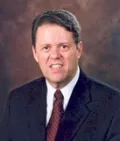
2008: James G. Neal
James G. Neal
Vice President for Information Services
and University Librarian
Columbia University
The 21st Annual Horace S. Manges Lecture took place on April 1, 2008. This year's lecturer was James G. Neal, Vice President for Information Services and University Librarian at Columbia University. Previously, he served as the Dean of University Libraries at Indiana University and Johns Hopkins University. He has represented the American library community in testimony on copyright matters before Congressional committees and is a member of the U.S. Copyright Office Section 108 Study Group. His speech was entitled "A Lay Perspective on the Copyright Wars: A Report From the Trenches of the Section 108 Study Group," and this lecture was published in the Columbia Journal of Law & the Arts Vol. 32, No. 2 (Winter 2009).
2007: Lionel Bently
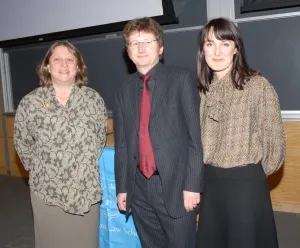
Left to right: Jane C. Ginsburg, The Morton L. Janklow Professor of Literary & Artistic Property Law; 2007 Manges Lecturer, Prof. Lionel Bently; and his wife, Clair Milligan
Professor Lionel Bently, the Herchel Smith Professor of Intellectual Property at Emmanuel College, University of Cambridge delivered the 20th Annual Horace S. Manges Lecture on Tuesday, April 10, 2007. His lecture was titled "People v. The Author: From the Death Penalty to Community Service." His lecture was published in the Columbia Journal of Law & the Arts and can be found at 32 Colum. J. L. Arts 1 (Fall 2008).
2006: Nick Taylor
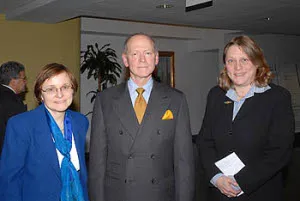
Left to right: Executive Director of the Kernochan Center, June M. Besek; 2006 Manges Lecturer, Nick Taylor; and the Morton L. Janklow Professor of Literary & Artistic Property Law, Jane C. Ginsburg
Nick Taylor delivered the 19th Annual Horace S. Manges Lecture on April 4, 2006. Mr. Taylor is a best-selling author, the immediate past president of the Authors Guild and director of the Authors Guild Foundation, a member of the literary organization PEN, and an advocate of copyright and fair contracts. Mr. Taylor's lecture was entitled "The Prospects for Copyright in a Bookless World." This lecture was published in the 30 Columbia Journal of Law & the Arts 2 (2007) issue.
2005 Paul Goldstein '67
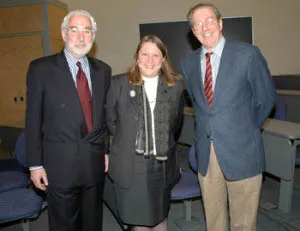
Left to right: Professor Paul Goldstein '67, Lillick Professor of Law, Stanford University; Professor Jane Ginsburg; and 2003 Manges Lecturer, Judge Pierre N. Leval
The 18th Annual Horace S. Manges Lecture was given by Paul Goldstein, Stella W. and Ira S. Lillick Professor of Law, Stanford University on "Copyright's Commons" on April 4, 2005. This lecture was published in 29 Columbia Journal of Law & the Arts 1 (2005).
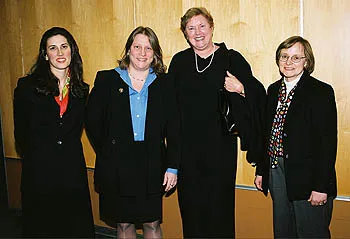
2004: Diane L. Zimmerman '76
Left to right: Margo E. Crespin, Asst. Director of the Kernochan Center; Professor Jane C. Ginsburg; 2004 Manges Lecturer, Prof. Diane L. Zimmerman; and June M. Besek, Executive Director of the Kernochan Center
Diane L. Zimmerman '76, Samuel Tilden Professor of Law, New York University School of Law delivered the 17th Annual Horace S. Manges Lecture at Columbia Law School on March 29, 2004. Professor Zimmerman spoke on "It's an Original!(?): In Pursuit of Copyright's Elusive Essence." This lecture was published in the 28 Columbia Journal of Law the Arts 187 (2005).
Past Horace S. Manges Lectures
1988 The Hon. Jon O. Newman
1989 The Hon. Robert W. Kastenmeier
1990 The Hon. Barbara A. Ringer '49
1991 Robert J. Coleman
1992 Prof. Sam Ricketson
1993 Jean-Francois Verstrynge
1994 Robert Wedgeworth
1995 Prof. J. Thomas McCarthy
1996 The Hon. Marybeth Peters
1997 Dr. Mihaly Ficsor
1998 The Hon. Howard Coble
1999 Stephen Manes
2000 Prof. Laura N. Gasaway
2001 Prof. Robert A. Gorman
2002 Prof. William R. Cornish
2003 The Hon. Pierre N. Leval
2004 Prof. Diane L. Zimmerman '76
2005 Prof. Paul L. Goldstein '67
2006 Nick Taylor
2007 Prof. Lionel Bently
2008 James G. Neal
2009 David O. Carson
2010 Prof. Robert P. Merges LLM '88
2011 Dr. Francis Gurry
2012 Prof. Robert Darnton
2013 The Hon. Maria A. Pallante
2014 Maria Martin-Prat
2015 R. Anthony Reese
2016 Brad Meltzer '96
2017 Shira Perlmutter
2018 R. Bruce Rich
2019 David Nimmer
2021 Karyn Temple '97
2022 The Hon. Margaret McKeown
2023 Prof. Raquel Xalabarder LLM '93
2024 Dale Cendali
2025 Prof. Peter Menell
2026 The Rt. Hon. Lord Justice Richard Arnold